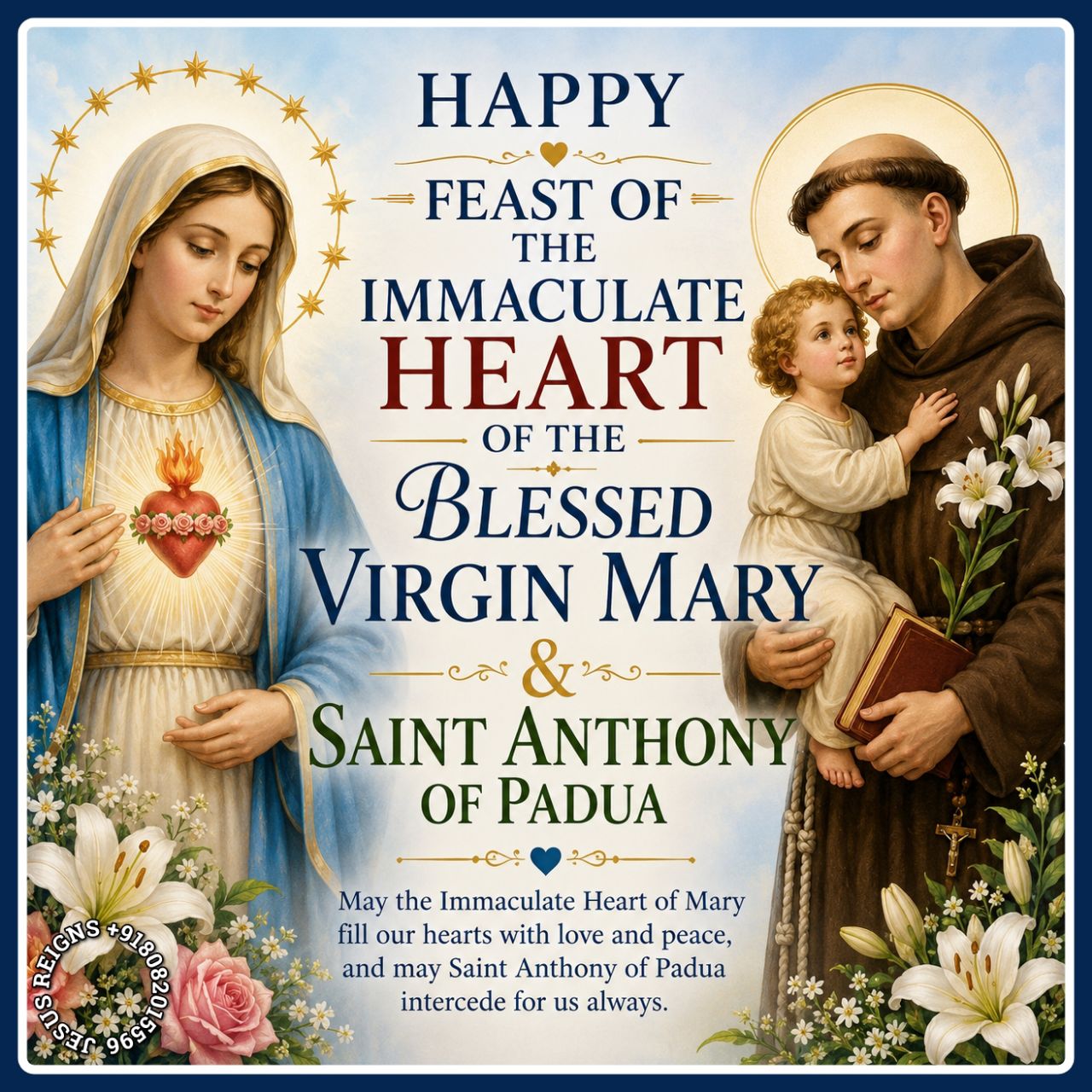
FEASTS OF THE DAY
SATURDAY, 13 JUNE, 2026
1) THE IMMACULATE HEART OF THE BLESSED VIRGIN MARY
2) SAINT ANTHONY OF PADUA
_
1) THE IMMACULATE HEART OF THE BLESSED VIRGIN MARY
Historically, devotion to the Heart of Mary grew up in parallel, but at a lesser intensity than that of devotion to the Heart of Jesus, only starting to become more prominent during the time of St. John Eudes.
John Eudes was born in 1601 in Normandy, France. He entered the Congregation of the Oratory of France, founded in 1611 by Cardinal de Berulle and was ordained to the priesthood on December 20, 1625.
St. John brought people to love Christ and the Virgin Mary by speaking tirelessly about their Heart, the sign of the love God shows for us and the communion to which we are called.
To offer them liturgical worship, he composed Masses and Offices in their honor and had the first Feast of the Holy Heart of Mary celebrated on February 8, 1648, at Autun (France,) and the Feast of the Heart of Jesus celebrated on October 20, 1672.
He died on August 19, 1680 and was canonized by Pope Pius XI on May 31, 1925.
Nevertheless, it was not until after the Apparitions at Rue du Bac concerning the "Miraculous Medal" made to Catherine Labouré in 1830, and the establishment of a society dedicated to the Immaculate Heart of Mary, at the Church of Our Lady of Victories in Paris in 1836, that this particular devotion became really well known.
Since then devotion to the Immaculate Heart of Mary, has gradually grown more widespread in the Church, particularly since the apparitions at Fatima.
The main difference between the devotions to the hearts of Jesus and Mary is that the one concerned with Jesus emphasizes his divine heart as being full of love for mankind, but with this love for the most part being ignored or rejected, while devotion to Mary's heart is essentially concerned with the love that her heart has for Jesus, for God.
Therefore, it is not an end in itself, so the love of her heart is meant to be a model for the way we should love God. The fact that her heart is immaculate, that is sinless, means that she is the only fully human person who is able to really love God in the way that He should be loved.
Honoring Mary's Immaculate Heart is really just another way of honoring Mary as the person who was chosen to be the Mother of God, recognizing her extraordinary holiness and the immense love she bestowed on Jesus as his mother, the person who was called to share in and co-operate in his redemptive sufferings.
The aim of the devotion is to unite mankind to God through Mary's heart, and this process involves the ideas of consecration and reparation. A person is consecrated to Mary's Immaculate Heart as a way of being completely devoted to God. This involves a total gift of self, something only ultimately possible with reference to God; but Mary is our intermediary in this process of consecration.
Because of the strong analogy between Jesus and Mary, the consecration to Mary's Immaculate Heart is closely linked to the consecration to Jesus' Sacred Heart, although it is subordinate and dependent on it. That is, although the act of consecration is ultimately addressed to God, it is an act that is made through Mary.
ACT OF CONSECRATION TO THE IMMACULATE HEART OF MARY
Most Holy Virgin Mary, tender Mother of men, to fulfill the desires of the Sacred Heart of Jesus and the request of the Vicar of Your Son on earth, we consecrate ourselves and our families to your Sorrowful and Immaculate Heart, O Queen of the Most Holy Rosary, and we recommend to You, all the people of our country and all the world.
Please accept our consecration, dearest Mother, and use us as You wish to accomplish Your designs in the world.
O Sorrowful and Immaculate Heart of Mary, Queen of the Most Holy Rosary, and Queen of the World, rule over us, together with the Sacred Heart of Jesus Christ, Our King. Save us from the spreading flood of modern paganism; kindle in our hearts and homes the love of purity, the practice of a virtuous life, an ardent zeal for souls, and a desire to pray the Rosary more faithfully.
We come with confidence to You, O Throne of Grace and Mother of Fair Love. Inflame us with the same Divine Fire which has inflamed Your own Sorrowful and Immaculate Heart. Make our hearts and homes Your shrine, and through us, make the Heart of Jesus, together with your rule, triumph in every heart and home. Amen.
- Venerable Pope Pius XII
Immaculate Heart of Mary: Pray for us!
_
2) SAINT ANTHONY OF PADUA
PRIEST AND DOCTOR
(15 August 1195 - 13 June 1231)
Saint Anthony was born Fernando Martins in Lisbon, Portugal. He was born into a wealthy family and by the age of fifteen asked to be sent to the Abbey of Santa Cruz in Coimbra, the then capital of Portugal. During his time in the Abbey, he learned theology and Latin.
Following his ordination to the priesthood, he was named guestmaster and was responsible for the abbey's hospitality. When Franciscan friars settled a small hermitage outside Coimbra dedicated to Saint Anthony of Egypt, Fernando felt a longing to join them.
Fernando eventually received permission to leave the Abbey so he could join the new Franciscan Order. When he was admitted, he changed his name to Anthony.
Anthony then traveled to Morocco to spread God's truth, but became extremely sick and was returned to Portugal to recover. The return voyage was blown off-course and the party arrived in Sicily, from which they traveled to Tuscany. Anthony was assigned to the hermitage of San Paolo after local friars considered his health.
As he recovered, Anthony spent his time praying and studying.
An undetermined amount of time later, Dominican friars came to visit the Franciscans and there was confusion over who would present the homily. The Dominicans were known for their preaching, thus the Franciscans assumed it was they who would provide a homilist, but the Dominicans assumed the Franciscans would provide one. It was then the head of the Franciscan hermitage asked Anthony to speak on whatever the Holy Spirit told him to speak of.
Though he tried to object, Anthony delivered an eloquent and moving homily that impressed both groups. Soon, news of his eloquence reached Francis of Assisi, who held a strong distrust of the brotherhood's commitment to a life of poverty. However, in Anthony, he found a friend.
In 1224, Francis entrusted his friars' pursuits of studies to Anthony. Anthony had a book of psalms that contained notes and comments to help when teaching students and, in a time when a printing press was not yet invented, he greatly valued it.
When a novice decided to leave the hermitage, he stole Anthony's valuable book. When Anthony discovered it was missing, he prayed it would be found or returned to him. The thief did return the book and in an extra step returned to the Order as well.
The book is said to be preserved in the Franciscan friary in Bologna today.
Anthony occasionally taught at the universities of Montpellier and Toulouse in southern France, but he performed best in the role of a preacher.
So simple and resounding was his teaching of the Catholic Faith, most unlettered and the innocent could understand his messages. It is for this reason he was declared a Doctor of the Church by Pope Pius XII in 1946.
Once, when St. Anthony of Padua attempted to preach the true Gospel of the Catholic Church to heretics who would not listen to him, he went out and preached his message to the fish. This was not, as liberals and naturalists have tried to say, for the instruction of the fish, but rather for the glory of God, the delight of the angels, and the easing of his own heart. When critics saw the fish begin to gather, they realized they should also listen to what Anthony had to say.
He was only 36-years-old when he died and was canonized less than one year afterward by Pope Gregory IX. Upon exhumation some 336 years after his death, his body was found to be corrupted, yet his tongue was totally incorrupt, so perfect were the teachings that had been formed upon it.
He is typically depicted with a book and the Infant Child Jesus and is commonly referred to today as the "finder of lost articles."
PATRON: illiterate and the poor, of sailors and fishermen, of priests and travelers,the finder of lost things, a protector and guardian of the mails, and wonder-worker.
EFFICACIOUS PRAYER TO ST. ANTHONY
O Holy Saint Anthony, one of the gentlest and kindest of all the Saints, your burning love of GOD, your exalted virtue and your great charity towards your fellow-creatures, made your worthy, when on earth, to possess miraculous powers of an exalted kind. Miracles waited on your word, and that word your were ever ready to speak at the request of those in trouble. the anxious prayer of bitter trial was never addressed to you in vain. to the sick you gave back health; you restored what was lost, the sorrow-stricken were the objects of your tender compassion - even the death you raised to life when the wounded heart cried out to you from the depths of anguish. When on earth nothing was impossible to you, except not to have compassion on those in distress and sorrow. encouraged by this thought, of confidence, i implore of you to obtain for me...
(mention your request...)
The answer to this, my prayer may require a miracle. Even so, are you not the saint of Miracles, who when on earth had but to speak and the mightiest wonders were wrought? O gentle and loving St. Anthony, you whose heart was ever full of human sympathy, whisper my prayer into the ears of the Infant JESUS who loved to linger in your arms.
One word from you and my prayer will be granted. Oh, speak that word and the gratitude of my heart will ever be yours. Amen.
_