DAILY READINGS & REFLECTION
JUNE 26, 2022
THIRTEENTH SUNDAY IN ORDINARY TIME
FIRST READING
1 KINGS 19:16, 19-21
16 and Jehu the son of Nimshi you shall anoint to be king over Israel; and Eli'sha the son of Shaphat of A'bel-meho'lah you shall anoint to be prophet in your place. 19 So he departed from there, and found Eli'sha the son of Shaphat, who was plowing, with twelve yoke of oxen before him, and he was with the twelfth. Eli'jah passed by him and cast his mantle upon him. 20 And he left the oxen, and ran after Eli'jah, and said, "Let me kiss my father and my mother, and then I will follow you." And he said to him, "Go back again; for what have I done to you?" 21 And he returned from following him, and took the yoke of oxen, and slew them, and boiled their flesh with the yokes of the oxen, and gave it to the people, and they ate. Then he arose and went after Eli'jah, and ministered to him.
The Word of the Lord
_
RESPONSORIAL PSALM
PSALMS 15(16):1-2, 5, 7-11
Response: Thou are my inheritance, O Lord.
Preserve me, O God, for in thee I take refuge.
I say to the LORD, “Thou art my LORD;
I have no good apart from thee.”
The LORD is my chosen portion and my cup;
thou holdest my lot.
R. Thou are my inheritance, O Lord.
I bless the LORD who gives me counsel;
in the night also my heart instructs me.
I keep the LORD always before me;
because he is at my right hand, I shall not be moved.
R. Thou are my inheritance, O Lord.
Therefore my heart is glad, and my soul rejoices;
my body also dwells secure.
For thou dost not give me up to Sheol,
or let thy godly one see the Pit.
R. Thou are my inheritance, O Lord.
Thou dost show me the path of life;
in thy presence there is fulness of joy,
in thy right hand are pleasures for evermore.
R. Thou are my inheritance, O Lord.
_
SECOND READING
GALATIANS 5:1, 13-18
1 For freedom Christ has set us free; stand fast therefore, and do not submit again to a yoke of slavery. 13 For you were called to freedom, brethren; only do not use your freedom as an opportunity for the flesh, but through love be servants of one another. 14 For the whole law is fulfilled in one word, "You shall love your neighbor as yourself." 15 But if you bite and devour one another take heed that you are not consumed by one another. 16 But I say, walk by the Spirit, and do not gratify the desires of the flesh. 17 For the desires of the flesh are against the Spirit, and the desires of the Spirit are against the flesh; for these are opposed to each other, to prevent you from doing what you would. 18 But if you are led by the Spirit you are not under the law.
The Word of the Lord
_
GOSPEL
No one who looks back is fit for the kingdom of God
LUKE 9:51-62
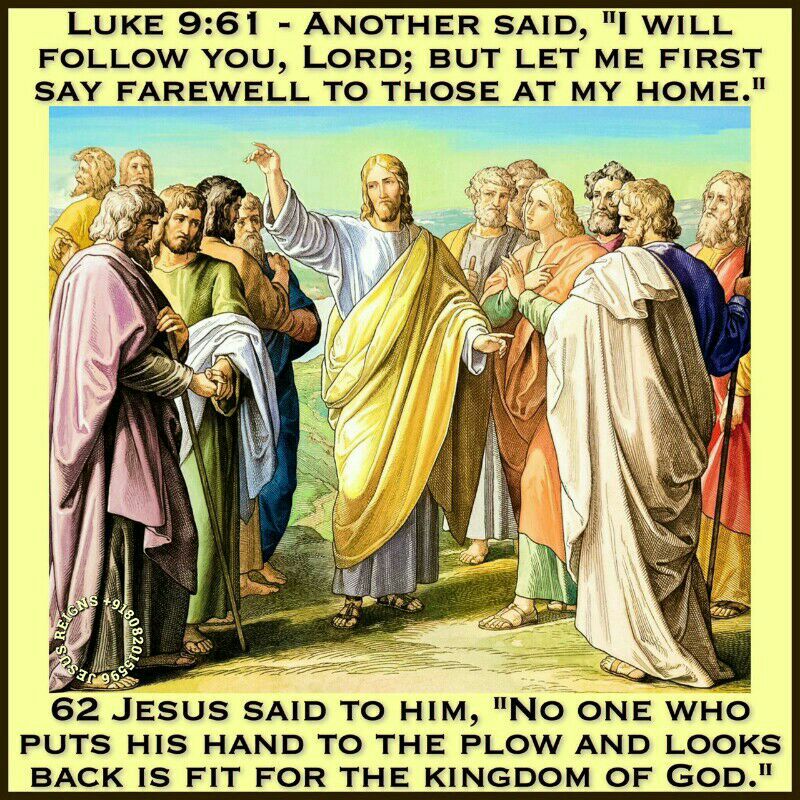
51 When the days drew near for him to be received up, he set his face to go to Jerusalem. 52 And he sent messengers ahead of him, who went and entered a village of the Samaritans, to make ready for him; 53 but the people would not receive him, because his face was set toward Jerusalem. 54 And when his disciples James and John saw it, they said, "Lord, do you want us to bid fire come down from heaven and consume them?" 55 But he turned and rebuked them. 56 And they went on to another village. 57 As they were going along the road, a man said to him, "I will follow you wherever you go." 58 And Jesus said to him, "Foxes have holes, and birds of the air have nests; but the Son of man has nowhere to lay his head." 59 To another he said, "Follow me." But he said, "Lord, let me first go and bury my father." 60 But he said to him, "Leave the dead to bury their own dead; but as for you, go and proclaim the kingdom of God." 61 Another said, "I will follow you, Lord; but let me first say farewell to those at my home." 62 Jesus said to him, "No one who puts his hand to the plow and looks back is fit for the kingdom of God."
The Gospel of the Lord
_
REFLECTION
DAILY QUOTE FROM THE EARLY CHURCH FATHERS
Jesus' disciples must bear insult and suffering patiently, by Cyril of Alexandria (376-444 AD)
"It would be false to affirm that our Savior did not know what was about to happen, because he knows all things. He knew, of course, that the Samaritans would not receive his messengers. There can be no doubt of this. Why then did he command them to go before him? It was his custom to benefit diligently the holy apostles in every possible way, and because of this, it was his practice sometimes to test them... What was the purpose of this occurrence? He was going up to Jerusalem, as the time of his passion was already drawing near. He was about to endure the scorn of the Jews. He was about to be destroyed by the scribes and Pharisees and to suffer those things that they inflicted upon him when they went to accomplish all of violence and wicked boldness. He did not want them to be offended when they saw him suffering. He also wanted them to be patient and not to complain greatly, although people would treat them rudely. He, so to speak, made the Samaritans' hatred a preparatory exercise in the matter. They had not received the messengers... For their benefit, he rebuked the disciples and gently restrained the sharpness of their wrath, not permitting them to grumble violently against those who sinned. He rather persuaded them to be patient and to cherish a mind that is unmovable by anything like this."
(excerpt from COMMENTARY ON LUKE, HOMILY 56)
_
Revised Standard Version Catholic Edition (RSVCE)
The Revised Standard Version of the Bible: Catholic Edition, copyright © 1965, 1966 the Division of Christian Education of the National Council of the Churches of Christ in the United States of America. Used by permission. All rights reserved.