FEASTS OF THE DAY
SUNDAY 3, JANUARY 2021
1)“THE FEAST OF THE MANIFESTATION OF OUR LORD” OR “EPIPHANY”
2) MOST HOLY NAME OF JESUS
_
1)“THE FEAST OF THE MANIFESTATION OF OUR LORD” OR “EPIPHANY”
In order to celebrate this feast of Manifestation more fully, we need to know more about the theology and significance of this great feast of Epiphany.
Elsa Chaney explains in layman's terms about this feast. Some of the references to the liturgy and divine office refer to pre-Vatican II rites, but all the insights are still applicable.
The feast of manifestation, or Epiphany, is traditionally celebrated the 12th day after Christmas, January 6th. In many dioceses this feast has been moved to the Sunday between January 2 and January 8.
DIRECTIONS: For many years in the English speaking world the feast of Epiphany has been overshadowed by that of Christmas. But unless we realize the significance of this great day, we see only one side of the mystery of the Incarnation. Now after contemplating the staggering fact that God has become a human child, we turn to look at this mystery from the opposite angle and realize that this seemingly helpless Child is, in fact, the omnipotent God, the King and Ruler of the universe. The feast of Christ's divinity completes the feast of His humanity. It fulfills all our Advent longing for the King "who is come with great power and majesty." We see that whereas Christmas is the family feast of Christianity, Epiphany is the great "world feast of the Catholic Church."
Epiphany is a complex feast: Originating in the Eastern Church and formed by the mentality of a people whose thought processes differ sharply from our own, the Epiphany is like a rich Oriental tapestry in which the various themes are woven and interwoven — now to be seen in their historical setting, again to be viewed from a different vantage point in their deep mystical significance. In this brief introduction four of the main ideas of the Epiphany will be outlined.
Divine manifestation: The Epiphany takes its name from the Greek epiphania, which denotes the visit of a god to earth. The first idea of the feast is the manifestation of Christ as the Son of God. "Begotten before the daystar and before all ages, the Lord our Savior is this day made manifest to the world." The feast unites three events in the life of Christ when His divinity, as it were, shines through His humanity: the adoration of the Magi; the baptism of Christ in the Jordan; and the first miracle at the wedding feast of Cana. Moreover, at Epiphany the Church looks forward to the majestic coming of Christ on the "youngest day" when His manifestation as God will be complete. The Gospels of the baptism and the marriage at Cana are read on the Octave Day and the Second Sunday after Epiphany, and later Sunday masses in the Epiphany season continue to show the divine power of our Lord in some of His most striking miracles.
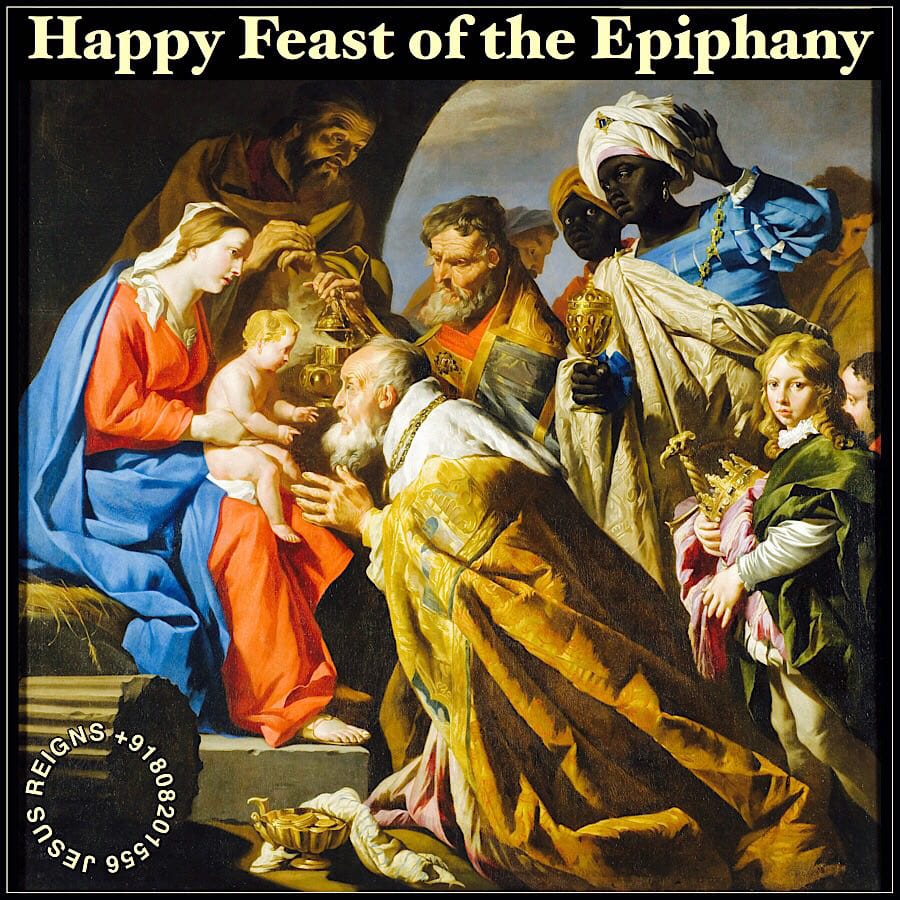
Royal kingship: A second important idea in Epiphany is the extension of Christ's kingship to the whole world. The revelation of Christ to the three kings at Bethlehem is a symbol of His revelation to the whole of the Gentile world. Epiphany presents to us the calling of not merely a chosen few, but all nations to Christianity.
Your Light is Come: Closely linked to both these themes of divine manifestation and world kingship is a third idea running through the Epiphany feast: that of light. During Advent, the world was in darkness, and we prayed and waited in the spirit of the Jewish nation which lived in expectation of the Coming Light during thousands of years. At Christmas the Light shone forth, but dimly, seen only by a few around the crib: Mary and Joseph and the shepherds. But at Epiphany the Light bursts forth to all nations and the prophecy is fulfilled: "The Gentiles shall walk in Thy light, and kings in the brightness of Thy rising." The mysterious star of Epiphany, "flashing like a flame," is still another facet of the light-motif, a symbol capable of being interpreted in a dozen different ways.
How much food for thought and reflection is contained in just these three ideas, and what a significance they have for our own time!
Epiphany lifts our eyes from the family celebrations and demands that we should include in our vision "all the ends of the earth." It demands that, like the three wise men, we should have the courage to follow the light of the star we have seen, however hazardous the journey; that the light of our faith, like that of the wise men, should be so strong that we are able to see and recognize our Lord and Ruler in however unexpected a way He may present Himself to us; and that having recognized Him, we should bow down and adore Him, offering Him our total loyalty.
Moreover, Epiphany demands that like these kings we should return to our own countries a different way, carrying to all those we meet the light of Christ. "For behold, darkness shall cover the earth," says the Epistle of the Epiphany Mass, "and a mist the people: but the Lord shall arise upon Thee, and His glory shall be seen upon Thee. And the Gentiles shall walk in Thy light. . ." These words may be applied to us, upon whom the light of Christ has indeed risen, and who have the responsibility to radiate that light in the darkness of our own world. It is clear how much the feast of Epiphany must mean to all who are engaged in the apostolate and are striving to extend the kingdom of Christ.
The royal nuptials: Besides the important ideas outlined above, there is still another great theme threaded through the Epiphany feast—the theme of the royal nuptials, the wedding of Christ with humanity. It is an idea on a completely different level from the historical events which the Epiphany celebrates, yet inextricably bound up with them; for example, the historical marriage feast of Cana is used by the Church to suggest the setting for Christ's nuptials with the Church; the wise men represent not only the three Persian Magi adoring the Babe 2000 years ago at Bethlehem, but also the Gentile world hurrying to the wedding feast at the end of time when mankind's nuptials with the divine Bridegroom will be celebrated; the gold, frankincense and myrrh are not only tokens for the little Baby King in the stable, but royal wedding gifts for the mystical marriage feast of heaven.
The Epiphany antiphon for the hour of Lauds brings out strikingly this theme of the divine marriage of Christ with humanity, and at the same time shows the deep mystical significance behind the historical events surrounding the feast. Perhaps nowhere more clearly than in this antiphon do we see that on Epiphany we do not commemorate a set of historical facts as much as we celebrate a great mystery: "This day the Church is joined to her heavenly Spouse, for Christ has cleansed her crimes in the Jordan. With gifts the Magi hasten to the royal nuptials, and the guests are gladdened with wine made from water."
Activity Source: "The Twelve Days of Christmas" by Elsa Chaney, The Liturgical Press, Collegeville, MN, 1955
EPIPHANY PRAYERS FOR THE HOME
Description: For the families that do not have an Epiphany home service, the following evening prayers are appropriate. Included is a short hymn for children.
Prayer:
Father: Christ has appeared among us.
All: Come, let us adore Him.
Mother: The precious gifts which the Magi brought to the Lord this day are threefold, and they are signs of divine mysteries. By gold the power of the King is signified, by frankincense His great priesthood, by myrrh the burial of the Lord.
All: The Magi worshipped the Author of our salvation in the crib, and of their treasures they brought to Him gifts of mystic nature.
Youngest Child: Glory be to the Father and to the Son and to the Holy Ghost.
All: As it was in the beginning, is now and ever shall be, world without end. Amen.
Father: Let us pray. O God, by the leading of a star Thou didst manifest Thine only begotten Son to the Gentiles on this day; mercifully grant that we who know Thee by faith, may be brought to contemplate the beauty of Thy majesty. Through the same Jesus Christ Thy Son.
All: Alleluia.
The Wise Men
tune Jesu Dulcis Memoria
Now there appeared a brilliant Star
Which led the wise Men from afar.
They came and, kneeling down, adored
And offered gifts to Christ, the Lord.
_
2) MOST HOLY NAME OF JESUS
This feast marks no progress in the development of the Church year. It merely embellishes the occasion just observed when the Child received the Name Jesus as had been foretold by the angel. The feast is meant to impress on us Christians the dignity of the Holy Name. It is a relatively new feast, stemming out of devotional piety. Nevertheless, it is not difficult to find in it some liturgical or ancient Christian dogma. What did a name signify originally? The name should express the nature of a thing. Thus Adam in paradise gave the animals names in accordance with their being. Among the Jews God's name expressed His essence, Yahweh, i.e., I (alone) am who am (and cause all else to be). The Jews had the highest respect for the name of God, a reverence that finds continuation in the Our Father: "Hallowed be Thy Name."
Persons who played prominent roles in the history of salvation often received their names from God Himself. Adam — man of the earth; Eve — mother of all the living; Abraham — father of many nations; Peter — the rock. The Savior's precursor was given the name God assigned him. According to divine precedent, then, the name of the Redeemer should not be accidental, of human choosing, but given by God Himself. For His name should express His mission.
We read in Sacred Scripture how the angel Gabriel revealed that name to Mary: "You shall call His name Jesus." And to St. Joseph the angel not merely revealed the name but explained its meaning: "You shall call His name Jesus, for He shall save His people from their sins." The Messiah should not only be the savior, but should be called Savior. With Jesus, therefore, the name actually tells the purpose of His existence. This is why we must esteem His name as sacred. Whenever we pronounce it, we ought to bow our heads; for the very name reminds us of the greatest favor we have ever received, salvation.
- Excerpted from The Church's Year of Grace, Pius Parsch
PRAYER: LORD JESUS, we humbly pray You to give us all a great reverence and respect for Your most holy name. Forgive us for ever having used the name of Jesus in vain, or without due respect.
Help us remember how reverently and lovingly Your Mother Mary used the name of Jesus, and how humbly Saint Joseph called You and spoke to You by name.
Your name, dear Jesus, is above every other name in heaven or on earth, because You are the Jesus, the Savior of all men. You have saved us, and You have told us to ask God anything in Your name, and it would be granted.
We ask You, humbly and confidently, to bless us and our work, and give us the rich treasures of Your divine grace, without which we cannot even so much as pronounce the name of Jesus. Amen.