DAILY READINGS & REFLECTION
Thursday of the Twenty-fifth week in Ordinary Time (September 26)
Suppressing truth to ease a guilty conscience
GOSPEL
Luke 9:7-9
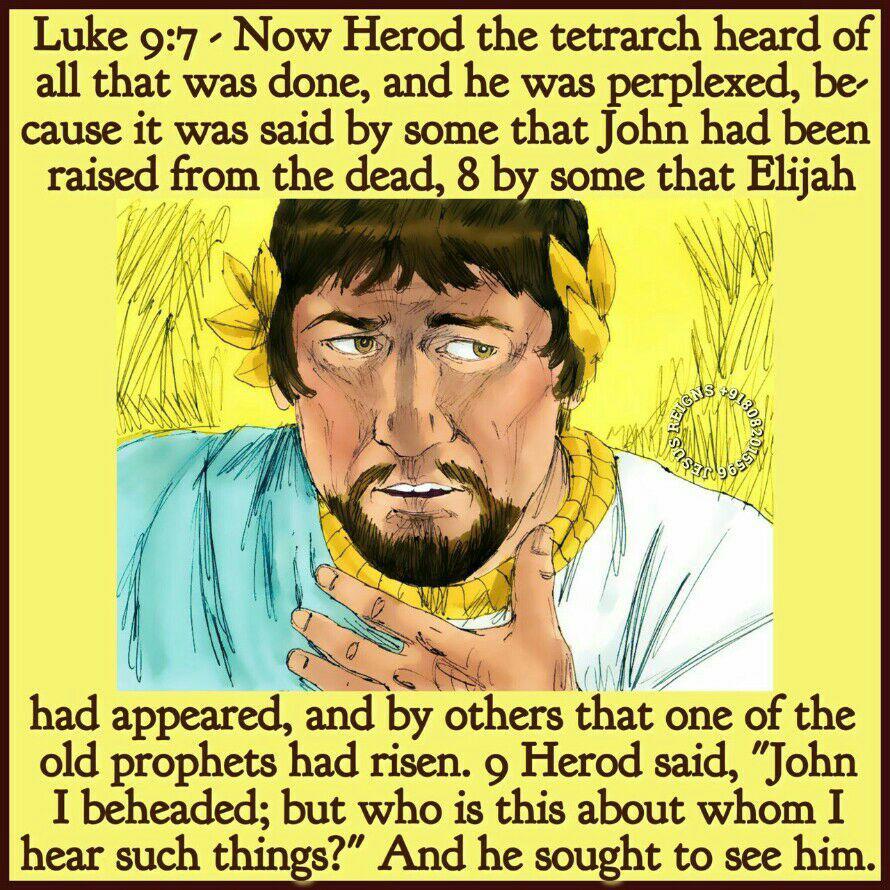
7 Now Herod the tetrarch heard of all that was done, and he was perplexed, because it was said by some that John had been raised from the dead, 8 by some that Elijah had appeared, and by others that one of the old prophets had risen. 9 Herod said, "John I beheaded; but who is this about whom I hear such things?" And he sought to see him.
The Gospel of the Lord
_
REFLECTION
Daily Quote from the early church fathers: Integrity is a hardship for the morally corrupt, by Peter Chrysologus (400-450 AD)
"John aroused Herod by his moral admonitions, not by any formal accusation. He wanted to correct, not to suppress. Herod, however, preferred to suppress rather than be reconciled. To those who are held captive, the freedom of the one innocent of wrongdoing becomes hateful. Virtue is undesirable to those who are immoral; holiness is abhorrent to those who are impious; chastity is an enemy to those who are impure; integrity is a hardship for those who are corrupt; frugality runs counter to those who are self-indulgent; mercy is intolerable to those who are cruel, as is loving-kindness to those who are pitiless and justice to those who are unjust. The Evangelist indicates this when he says, "John said to him, 'It is not lawful for you to have the wife of your brother Philip.'" This is where John runs into trouble. He who admonishes those who are evil gives offense. He who repudiates wrongdoers runs into trouble. John was saying what was proper of the law, what was proper of justice, what was proper of salvation and what was proper certainly not of hatred but of love. And look at the reward he received from the ungodly for his loving concern!"
(excerpt from SERMONS 127.6-7)
_
FIRST READING
Haggai 1:1-8
1 In the second year of Darius the king, in the sixth month, on the first day of the month, the word of the LORD came by Haggai the prophet to Zerub'babel the son of She-al'ti-el, governor of Judah, and to Joshua the son of Jehoz'adak, the high priest, 2 "Thus says the LORD of hosts: This people say the time has not yet come to rebuild the house of the LORD." 3 Then the word of the LORD came by Haggai the prophet, 4 "Is it a time for you yourselves to dwell in your paneled houses, while this house lies in ruins? 5 Now therefore thus says the LORD of hosts: Consider how you have fared. 6 You have sown much, and harvested little; you eat, but you never have enough; you drink, but you never have your fill; you clothe yourselves, but no one is warm; and he who earns wages earns wages to put them into a bag with holes. 7 "Thus says the LORD of hosts: Consider how you have fared. 8 Go up to the hills and bring wood and build the house, that I may take pleasure in it and that I may appear in my glory, says the LORD.
_
RESPONSORIAL PSALM
PSALM 149:1-2, 3-4, 5-6, 9
Response: The Lord takes delight in his people.
Sing to the LORD a new song
of praise in the assembly of the faithful.
Let Israel be glad in their maker,
let the children of Zion rejoice in their king.
R. The Lord takes delight in his people.
Let them praise his name in the festive dance,
let them sing praise to him with timbrel and harp.
For the LORD loves his people,
and he adorns the lowly with victory.
R. The Lord takes delight in his people.
Let the faithful exult in glory;
let them sing for joy upon their couches;
Let the high praises of God be in their throats.
This is the glory of all his faithful. Alleluia.
R. The Lord takes delight in his people.
_
Revised Standard Version Catholic Edition (RSVCE)
The Revised Standard Version of the Bible: Catholic Edition, copyright © 1965, 1966 the Division of Christian Education of the National Council of the Churches of Christ in the United States of America. Used by permission. All rights reserved.