DAILY READINGS & REFLECTION
Friday - Saints Cyril, Monk and Methodius, Bishop - Memorial (February 14)
"He has done all things well"
GOSPEL
Mark 7:31-37 (Alternate Reading: Luke 10:1-9)
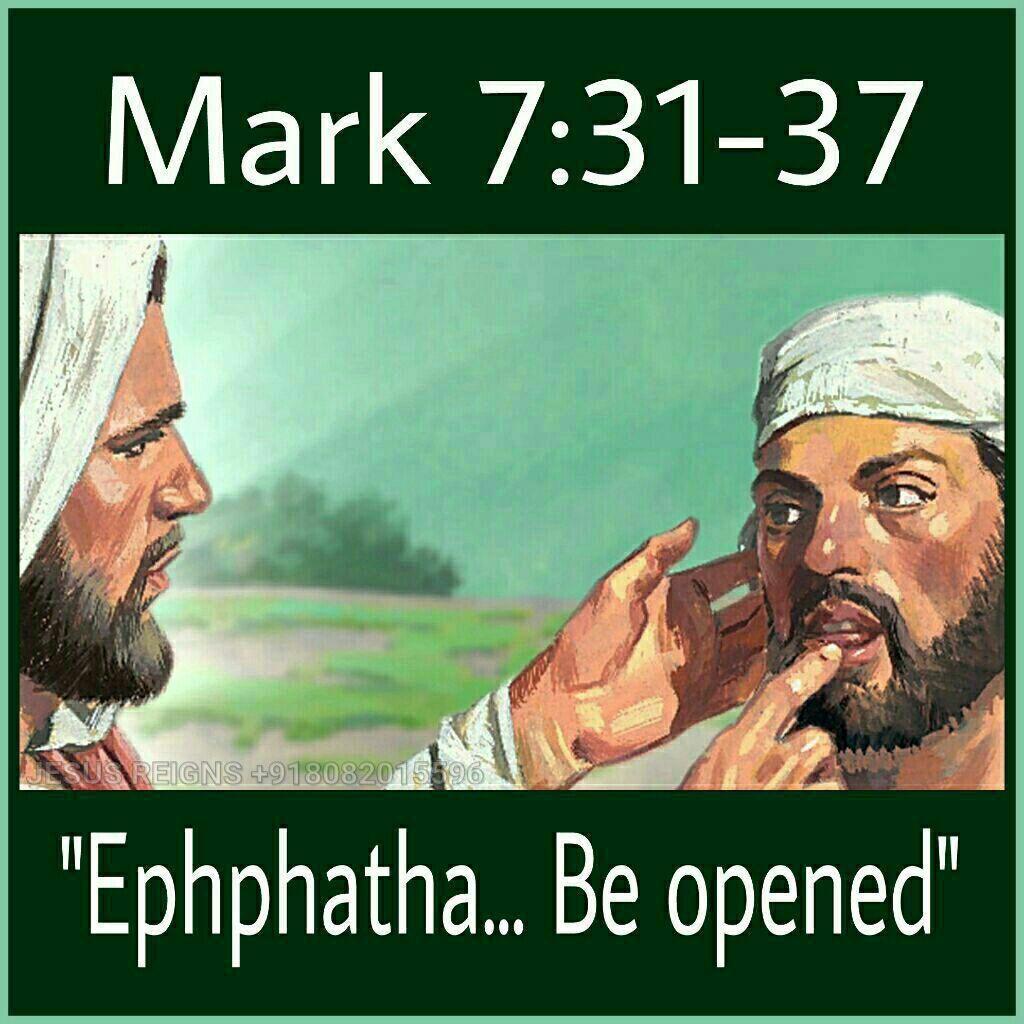
31 Then he returned from the region of Tyre, and went through Sidon to the Sea of Galilee, through the region of the Decapolis. 32 And they brought to him a man who was deaf and had an impediment in his speech; and they begged him to lay his hand upon him. 33 And taking him aside from the multitude privately, he put his fingers into his ears, and he spat and touched his tongue; 34 and looking up to heaven, he sighed, and said to him, "Ephphatha," that is, "Be opened." 35 And his ears were opened, his tongue was released, and he spoke plainly. 36 And he charged them to tell no one; but the more he charged them, the more zealously they proclaimed it. 37 And they were astonished beyond measure, saying, "He has done all things well; he even makes the deaf hear and the mute speak."
The Gospel of the Lord
_
REFLECTION
Daily Quote from the early church fathers: The touch of the Lord, by Ephrem the Syrian (306-373 AD)
"That power which may not be handled came down and clothed itself in members that may be touched, that the desperate may draw near to him, that in touching his humanity they may discern his divinity. For that speechless man the Lord healed with the fingers of his body. He put his fingers into the man's ears and touched his tongue. At that moment with fingers that may be touched, he touched the Godhead that may not be touched. Immediately this loosed the string of his tongue (Mark 7:32-37), and opened the clogged doors of his ears. For the very architect of the body itself and artificer of all flesh had come personally to him, and with his gentle voice tenderly opened up his obstructed ears. Then his mouth which had been so closed up that it could not give birth to a word, gave birth to praise him who made its barrenness fruitful. The One who immediately had given to Adam speech without teaching, gave speech to him so that he could speak easily a language that is learned only with difficulty (Genesis 1:27-28).
(excerpt from HOMILY ON OUR LORD 10.3)
_
FIRST READING
1 Kings 11:29-32; 12:19 (Alternate Reading: Acts 13:46-49)
11 29 And at that time, when Jerobo'am went out of Jerusalem, the prophet Ahi'jah the Shi'lonite found him on the road. Now Ahi'jah had clad himself with a new garment; and the two of them were alone in the open country. 30 Then Ahi'jah laid hold of the new garment that was on him, and tore it into twelve pieces. 31 And he said to Jerobo'am, "Take for yourself ten pieces; for thus says the LORD, the God of Israel, `Behold, I am about to tear the kingdom from the hand of Solomon, and will give you ten tribes 32 (but he shall have one tribe, for the sake of my servant David and for the sake of Jerusalem, the city which I have chosen out of all the tribes of Israel), 12 19 So Israel has been in rebellion against the house of David to this day.
_
RESPONSORIAL PSALM
PSALM 80(81):10-11, 12-13, 14-15
Response: I am the Lord, your God: hear my voice.
“There shall be no strange god among you
nor shall you worship any alien god.
I, the LORD, am your God
who led you forth from the land of Egypt.”
R. I am the Lord, your God: hear my voice.
“My people heard not my voice,
and Israel obeyed me not;
So I gave them up to the hardness of their hearts;
they walked according to their own counsels.”
R. I am the Lord, your God: hear my voice.
“If only my people would hear me,
and Israel walk in my ways,
Quickly would I humble their enemies;
against their foes I would turn my hand.”
R. I am the Lord, your God: hear my voice.
_
Revised Standard Version Catholic Edition (RSVCE)
The Revised Standard Version of the Bible: Catholic Edition, copyright © 1965, 1966 the Division of Christian Education of the National Council of the Churches of Christ in the United States of America. Used by permission. All rights reserved.