DAILY READINGS & REFLECTION
MAY 29, 2026
FRIDAY OF THE EIGHTH WEEK IN ORDINARY TIME
(OPTIONAL MEMORIAL OF SAINT PAUL VI, POPE)
FIRST READING
1 PETER 4:7-13 OR (1 CORINTHIANS 9:16-19, 22-23)
7 The end of all things is at hand; therefore keep sane and sober for your prayers. 8 Above all hold unfailing your love for one another, since love covers a multitude of sins. 9 Practice hospitality ungrudgingly to one another. 10 As each has received a gift, employ it for one another, as good stewards of God's varied grace: 11 whoever speaks, as one who utters oracles of God; whoever renders service, as one who renders it by the strength which God supplies; in order that in everything God may be glorified through Jesus Christ. To him belong glory and dominion for ever and ever. Amen. 12 Beloved, do not be surprised at the fiery ordeal which comes upon you to prove you, as though something strange were happening to you. 13 But rejoice in so far as you share Christ's sufferings, that you may also rejoice and be glad when his glory is revealed.
The Word of the Lord
_
RESPONSORIAL PSALM
PSALMS 96(97):10-13 OR (PSALMS 96:1-3, 7-8, 10)
Response: The Lord comes to judge the earth.
Say among the nations, “The LORD reigns!
Yea, the world is established, it shall never be moved;
he will judge the peoples with equity.”
R. The Lord comes to judge the earth.
Let the heavens be glad, and let the earth rejoice;
let the sea roar, and all that fills it;
let the field exult, and everything in it!
Then shall all the trees of the wood sing for joy.
R. The Lord comes to judge the earth.
Before the LORD, for he comes,
for he comes to judge the earth.
He will judge the world with righteousness,
and the peoples with his truth.
R. The Lord comes to judge the earth.
_
GOSPEL
Have faith in God
MARK 11:11-26 OR (MATTHEW 16:13-19)
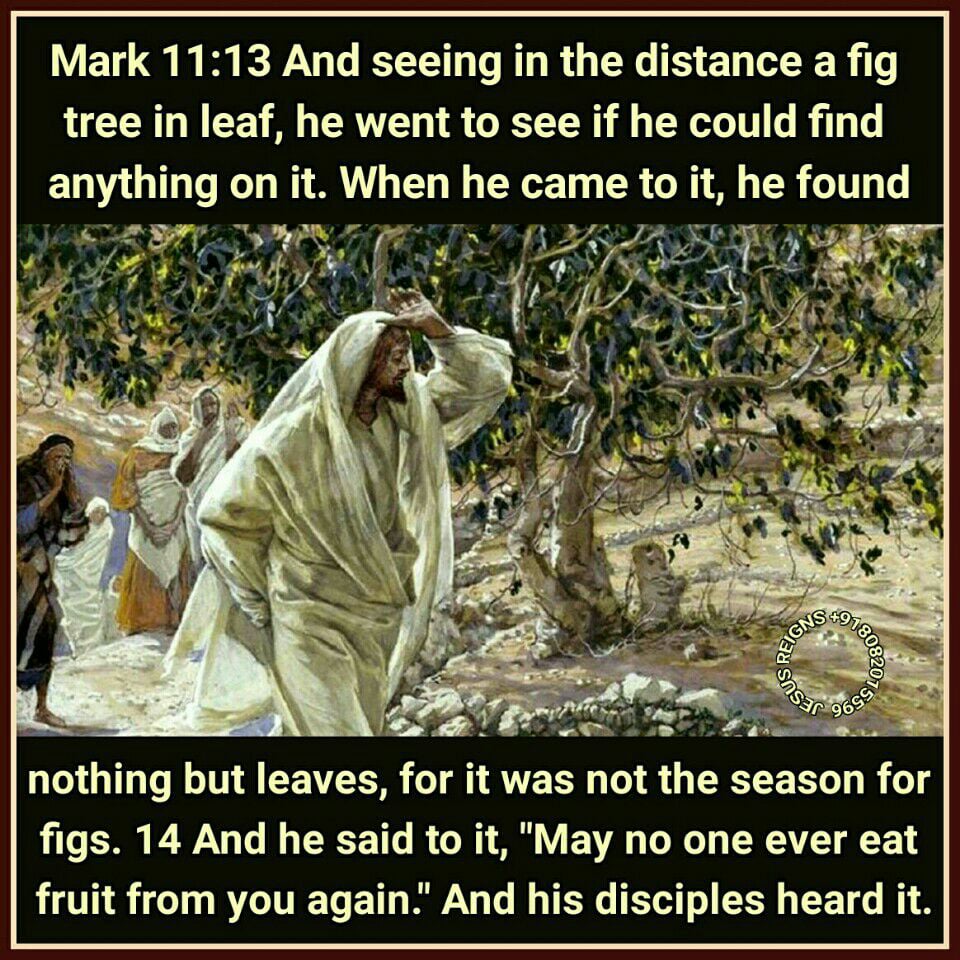
11 And he entered Jerusalem, and went into the temple; and when he had looked round at everything, as it was already late, he went out to Bethany with the twelve. 12 On the following day, when they came from Bethany, he was hungry. 13 And seeing in the distance a fig tree in leaf, he went to see if he could find anything on it. When he came to it, he found nothing but leaves, for it was not the season for figs. 14 And he said to it, "May no one ever eat fruit from you again." And his disciples heard it.
15 And they came to Jerusalem. And he entered the temple and began to drive out those who sold and those who bought in the temple, and he overturned the tables of the money-changers and the seats of those who sold pigeons; 16 and he would not allow any one to carry anything through the temple. 17 And he taught, and said to them, "Is it not written, `My house shall be called a house of prayer for all the nations'? But you have made it a den of robbers." 18 And the chief priests and the scribes heard it and sought a way to destroy him; for they feared him, because all the multitude was astonished at his teaching.
19 And when evening came they went out of the city. 20 As they passed by in the morning, they saw the fig tree withered away to its roots. 21 And Peter remembered and said to him, "Master, look! The fig tree which you cursed has withered." 22 And Jesus answered them, "Have faith in God. 23 Truly, I say to you, whoever says to this mountain, `Be taken up and cast into the sea,' and does not doubt in his heart, but believes that what he says will come to pass, it will be done for him. 24 Therefore I tell you, whatever you ask in prayer, believe that you have received it, and it will be yours. 25 And whenever you stand praying, forgive, if you have anything against any one; so that your Father also who is in heaven may forgive you your trespasses. 26 But if you do not forgive, neither will your Father who is in heaven forgive your trespasses"
The Gospel of the Lord
_
REFLECTION
DAILY QUOTE FROM THE EARLY CHURCH FATHERS
Attaining the fruit of mercy and goodness in the school of Christ, by Augustine of Hippo, 354-430 A.D.
"Some who witnessed Christ's miracles did not understand what they meant, and how they spoke to those who knew they had special meaning. They wondered only at the miracles themselves. Others both marveled at the miracles, and attained some preliminary understanding of them. For this we must come to the school of Christ himself. Those fixed only upon the plain sense of Scripture tend to focus merely upon miracle for miracles' sake. Hence they may prematurely conclude that Jesus himself was ignorant of the time of the year, something any ordinary farmer could discern. For it was not yet the season for the tree to bear fruit. Nevertheless, since he was hungry, he looked for fruit on the tree (Mark 11:13). Does this imply that Christ knew less than what every peasant could easily discern? Surely not. Wouldn't you expect the maker of the fig tree to know what the ordinary orchard worker would know in a snap? So when he was hungry he looked for fruit on the tree, but he seemed to be looking for something more from this tree. He noted that the tree had no fruit, but was full of leaves. It was at that point that he cursed it, and it withered away. So what terrible thing had the poor tree done simply in not bearing fruit? Could the tree reasonably be faulted for its fruitlessness? No. But human beings who by their own free will decide not to bear fruit - that is a different matter. Those found wanting in accountability in this case are those who had the benefit of the law, which was meant to bear fruit, but they had no fruit to show for it. They had a full growth of leaves (the law), yet they bore no fruit (works of mercy)."
(excerpt from SERMONS ON NEW TESTAMENT LESSONS 48.3.16)
_
Revised Standard Version Catholic Edition (RSVCE)
The Revised Standard Version of the Bible: Catholic Edition, copyright © 1965, 1966 the Division of Christian Education of the National Council of the Churches of Christ in the United States of America. Used by permission. All rights reserved.